
German Quality in Motion:
Doffing for filament solutions
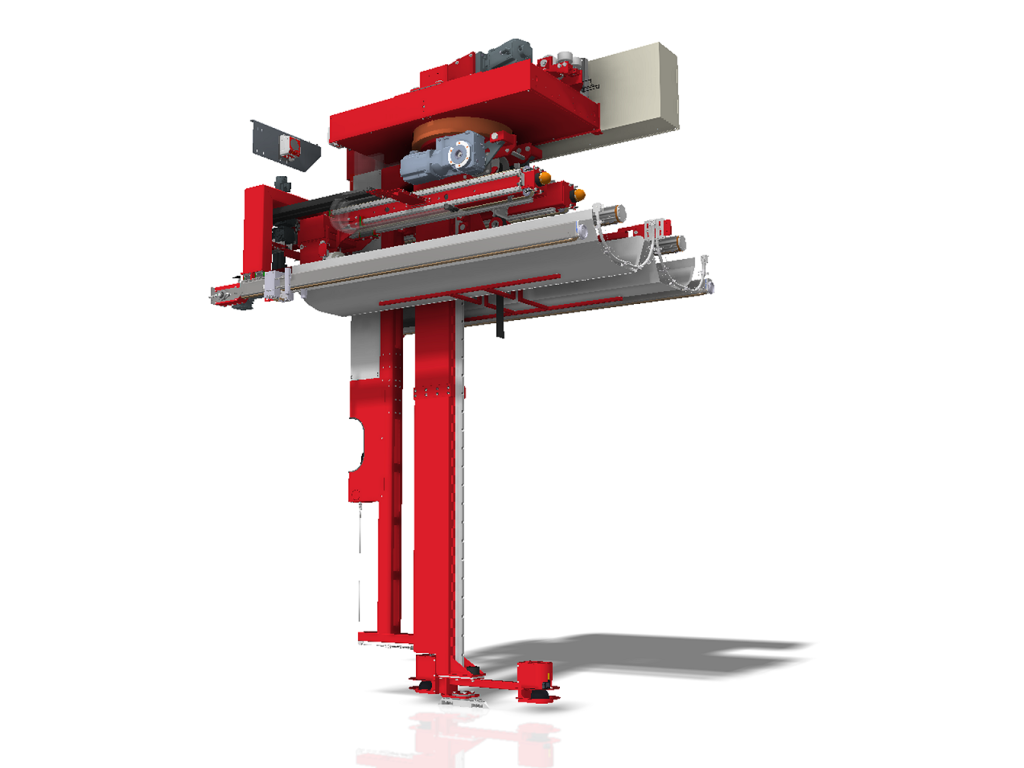
The main component of a doffer aisle in the filament industry is the doffer, which is used to pick up the full bobbins from the winders („doffing“) and feed them safely into the further process. The doffer typically consists of a rotating pick-up device for the bobbins, which allows the doffer to easily remove them, as well as an optional mechanism to put the empty bobbins back into the winder. The efficiency and reliability of the doffer are features that characterize our product.
Therefor a doffer is an essential component in the filament manufacturing process, and representing our backbone’s technology.
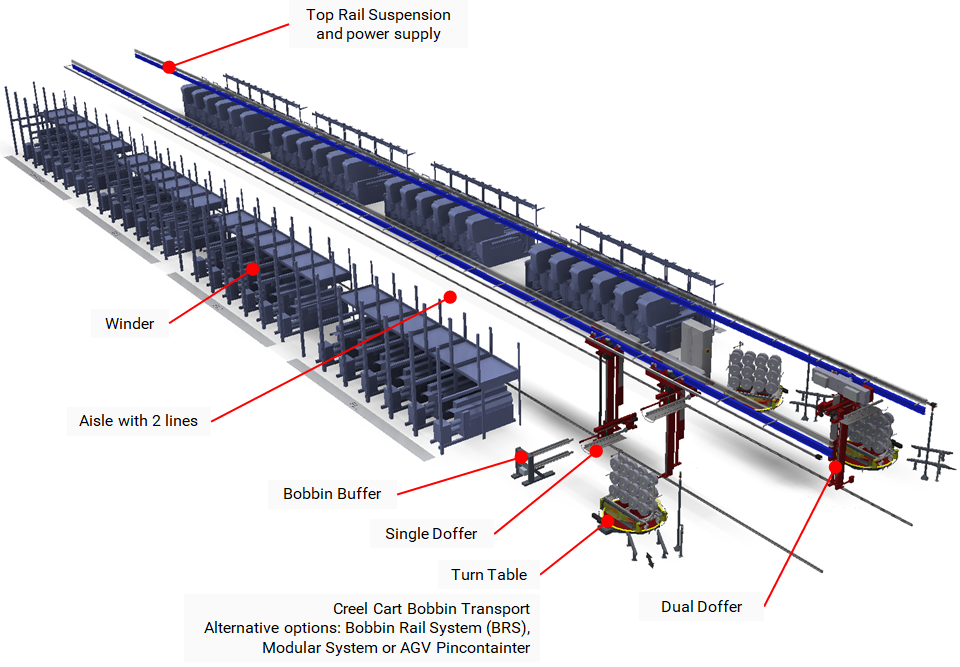

Single and Dual Doffers, it’s up to you
In a Single doffer configuration, one doffing coil handles the removal of full bobbins. This system is efficient for operations with moderate production demands.
The Dual Doffer however features two doffing coils (or stations) working in tandem. While one station removes the full bobbins, the second station is ready to be filled during the doffing procedure of another winder. This arrangement significantly increases the speed and efficiency of the doffing process, making it suitable for high-production environments.
Data Transfer via Optical Communication
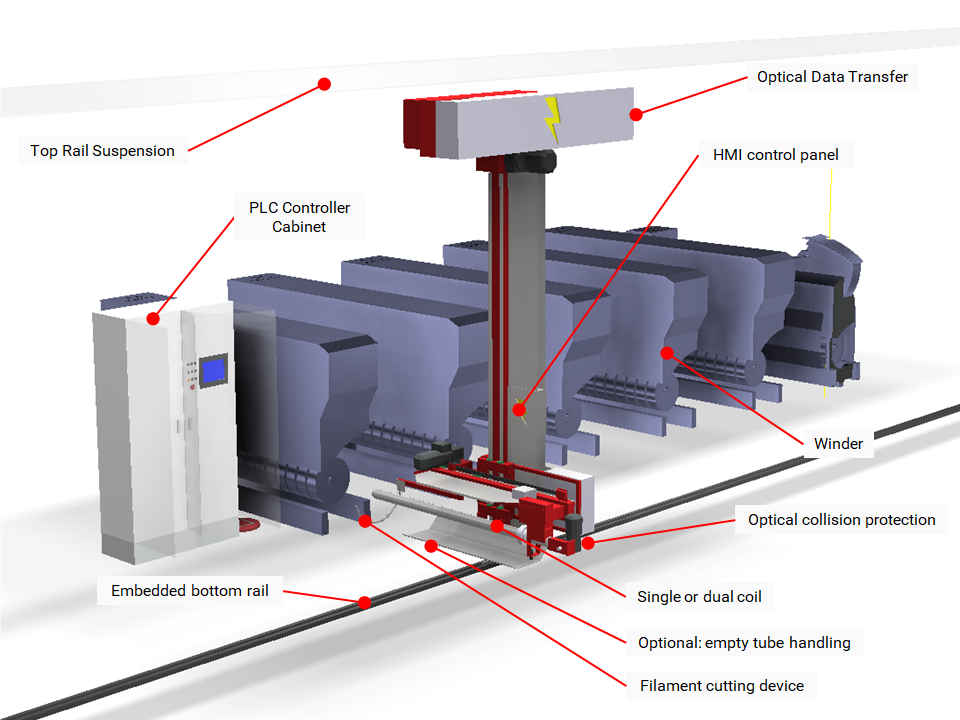
Our doffers come equipped with optical data transfer units, that are used for communication within the doffer system. This means, that data acquired by the doffer is transmitted to the central control unit, vice versa the order management is being sent to the doffer’s control data interface with process through the winders is granted as well.
The light data transfer provides real-time data to the control system, enabling precise synchronization of the doffing process. This data ensures that the system operates smoothly and efficiently.
Safety Features
The doffer system is equipped with safety sensors to detect any obstructions or malfunctions. These sensors can halt the operation immediately to prevent accidents.
Emergency stop buttons are strategically placed around the doffer to allow operators to quickly stop the machine if a safety issue arises.
Safety Sensors and protective Ripcords are installed to protect operators from moving parts and to prevent accidental contact with the machine during operation. One of the most important components is the optical sensor system, which enables the detection of „interfering objects“ in the doffer’s travel path, but also recognizes personnel who must be present in the doffer lane, for example for the manual application of empty bobbins (if this option has not been selected for the doffer) or for maintenance work.


Empty Tube Handling
The doffer system can be equipped with an optional empty tube handling system. that automates the placement of empty tubes onto the winding machine. This system is designed to automate the manual process of placing empty tubes onto the winder, significantly improving efficiency and reducing labor requirements.
Empty tubes are stored in a designated area, and the doffer system retrieves and positions them precisely onto the winding spindles. Advanced sensors and robotic arms ensure accurate placement and secure fitting of the tubes.
By integrating the empty tube handling system at the doffer, filament manufacturers can achieve a higher level of automation, reducing manual labor, increasing efficiency, and ensuring consistent and reliable operation of the winding process.
By automating the placement of empty tubes, the system allows operators to focus on other critical tasks, thereby increasing overall productivity and efficiency in the production line.
Yarn Cutting device
A yarn cutter on the doffer is a specialized feature designed to thermally sever loose yarns between the doffer and the winder. This process ensures clean separation and prevents tangling or damage to the yarn and equipment.
The yarn cutter employs a heating element, that rapidly reaches a high temperature. When activated, the heated element comes into contact with the yarn, melting through it quickly and cleanly.

The cutting mechanism is usually controlled electronically and can be activated automatically by the doffer’s control system when the doffing process begins. To ensure operator safety, the heated cutting element is typically enclosed within protective guards that prevent accidental contact.
The heating element comes equipped with an automatic shut-off feature that deactivates the cutter when not in use, preventing overheating and reducing energy consumption. It is also a benefit for general safety issues.
A doffer is a crucial piece of equipment in the textile manufacturing process, ensuring the efficient removal of full bobbins and the precise placement of empty tubes to maintain continuous production. Single and dual doffer systems cater to different production needs, with dual doffers offering higher efficiency. The integration of automated empty tube handling enhances productivity and reduces manual labor. Safety features such as sensors, emergency stops, and protective guards ensure safe operation, while data transfer via light barriers enables real-time monitoring and quality control. By leveraging these advanced functionalities, textile manufacturers can optimize their production processes and achieve higher levels of efficiency and safety.